

Best Examples of AI in Marketing in 2026 showcase how artificial intelligence has moved from experimental technology to a core competitive advantage for forward-thinking brands. Artificial Intelligence is no longer a futuristic concept in marketing — it has become the driving force behind smarter campaigns, hyper-personalized experiences, predictive customer behavior, and exceptional marketing efficiency.
Table of Contents
In today’s fast-evolving digital landscape, businesses that effectively implement AI in marketing are achieving significantly higher engagement rates, improved conversion rates, and better return on investment (ROI). From generative AI tools creating complete ad campaigns to advanced machine learning algorithms delivering real-time personalization at scale, AI is fundamentally transforming every aspect of modern marketing strategies.
This comprehensive guide explores the best examples of AI in marketing across key areas including hyper-personalization, content creation and SEO, viral creative campaigns, intelligent chatbots, customer experience enhancement, and predictive analytics for advertising optimization. You’ll discover how industry giants like Starbucks, Nike, Coca-Cola, Sephora, and Popeyes are successfully leveraging AI marketing tools to stay ahead of their competitors.
Whether you’re a digital marketer, business owner, or SEO professional, these real-world AI marketing case studies will provide practical insights and actionable inspiration. We’ll also cover the latest statistics, benefits, challenges, and a step-by-step guide to help you start implementing AI in your own marketing efforts.
By the end of this article, you’ll understand exactly how leading brands are using generative AI, predictive analytics, recommendation engines, and autonomous AI agents to revolutionize their marketing performance in 2026.
Ready to explore the future of marketing? Let’s dive into the most impactful and innovative examples of AI in marketing happening right now.
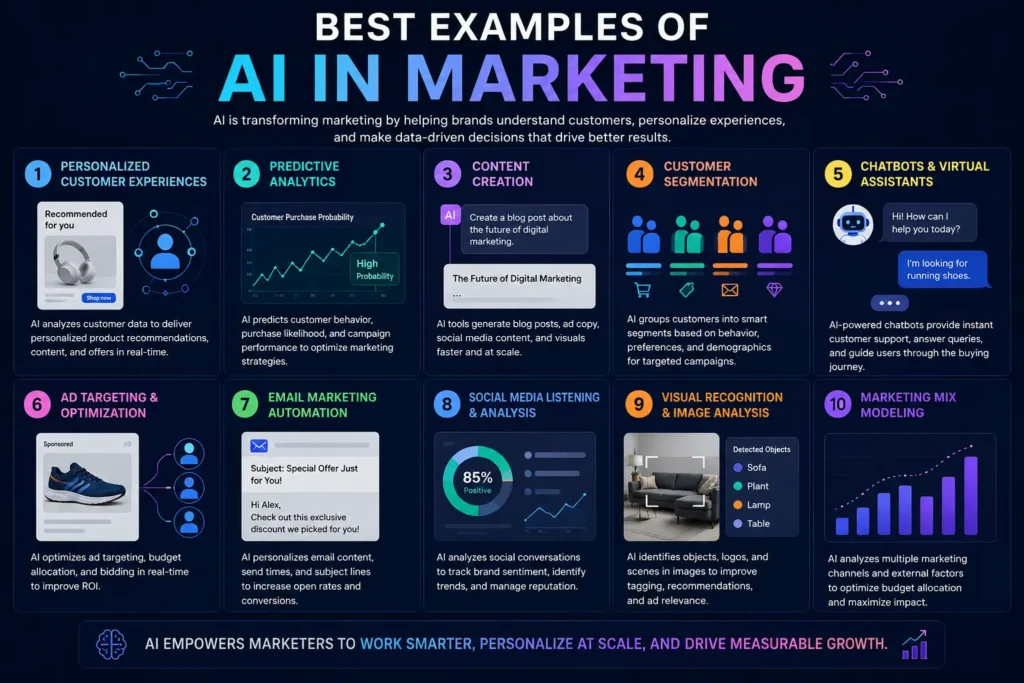
AI is not replacing marketers — it is empowering them to work smarter, faster, and more creatively than ever before.
Hyper-Personalization at Scale
One of the best examples of AI in marketing is hyper-personalization. Brands are now delivering real-time, individualized experiences that feel almost magical to customers.
Starbucks uses its Deep Brew AI platform to analyze purchase history, weather, time of day, and location. This results in highly accurate personalized recommendations that have significantly increased customer loyalty and app sales.
Nike is another excellent case study in the best examples of AI in marketing. During major sporting events, Nike used AI-powered audience clustering to deliver personalized video content, resulting in over 33% higher watch-through rates.
How Hyper-Personalization Works in 2026
Modern AI systems combine behavioral data, contextual signals, and machine learning to predict customer needs before they even express them. This level of personalization is now a key differentiator in competitive markets.
AI-Powered Content Creation and SEO
Another powerful area among the best examples of AI in marketing is content production. Generative AI has made content creation faster and more effective than ever before.
Brands like Coca-Cola have successfully used AI tools to refresh their iconic campaigns with new creative assets in record time. Tools such as Jasper, Claude, and Surfer SEO are helping marketers optimize content for both quality and search rankings.
Viral Creative Campaigns with AI
The best examples of AI in marketing also include some unforgettable viral campaigns.
Popeyes AI Diss Track was created in just 3 days using Google’s Veo 3 and became a massive hit online. Similarly, Mango’s “Sunset Dream” campaign was entirely AI-generated and received widespread appreciation for its visual quality.
Impact of AI on Creative Marketing
These campaigns prove that AI doesn’t kill creativity — it actually amplifies it when used strategically. Brands are now able to test multiple creative variations quickly and launch winning ideas faster.
Predictive Analytics and Ad Optimization
Predictive analytics is one of the most powerful best examples of AI in marketing in 2026. It helps brands forecast customer behavior, optimize ad spend, and deliver the right message at the right time.
Bayer created an outstanding case study in the best examples of AI in marketing. By using AI for flu trend forecasting, the brand achieved 85% higher click-through rates (CTR), 33% lower cost per click, and 2.6x more website traffic.
How Predictive Analytics Powers Modern Marketing
AI-powered predictive models analyze historical data, real-time signals, and external factors to predict customer actions such as purchases, churn, or engagement. This allows marketers to automate bidding, audience targeting, and budget allocation with high accuracy.
Google Performance Max and Meta Advantage+ are now running almost entirely on predictive AI. These platforms continuously test thousands of creative combinations and optimize campaigns in real time, making them one of the smartest best examples of AI in marketing available today.
Many leading brands are also using predictive analytics for dynamic pricing, lifetime value prediction, and personalized email timing — resulting in significantly higher ROI compared to traditional marketing methods.
Chatbots, Virtual Assistants & Customer Experience
Intelligent chatbots and virtual assistants are among the most practical best examples of AI in marketing. They are transforming customer service into a proactive, personalized, and revenue-generating channel.
Sephora’s Virtual Artist is a standout case in the best examples of AI in marketing. Using AI and facial recognition, it allows customers to virtually try on makeup, which has significantly reduced return rates and increased online sales.
A.S. Watson Group (Asia’s largest health & beauty retailer) deployed an AI Skincare Advisor that provides personalized product recommendations, improving customer satisfaction without increasing staff.
Domino’s “Dom” voice AI enables seamless ordering through conversation, turning traditional customer support into a smooth sales experience.
The Future of Conversational Marketing
In 2026, AI agents can handle complex customer journeys — from lead qualification to post-purchase support — 24/7, delivering human-like experiences at scale.
Benefits of AI in Marketing
The best examples of AI in marketing clearly show multiple powerful benefits that forward-thinking brands are enjoying in 2026:
- Higher Efficiency: Marketers are achieving 10–55% productivity gains through generative AI and automation.
- Better Personalization: Hyper-personalized campaigns are driving significantly higher engagement and conversion rates.
- Improved ROI: Predictive analytics and automated ad optimization are reducing costs while increasing results, as seen in Bayer’s campaign.
- Faster Campaign Execution: Brands can now create, test, and launch campaigns in days instead of weeks.
- Scalable Customer Experience: AI handles millions of personalized interactions without compromising quality.
According to recent reports, 92% of businesses are increasing their investment in generative AI for marketing, proving its massive impact.
Challenges & Best Practices
While the best examples of AI in marketing are inspiring, implementing AI comes with certain challenges.
Key challenges include maintaining brand voice, avoiding bias in AI outputs, data privacy concerns, and over-reliance on automation. Many brands also struggle with integrating AI tools into existing systems.
Best Practices for Success in 2026
- Always maintain Human + AI collaboration — use AI as a powerful assistant, not a complete replacement.
- Keep strong human oversight on all AI-generated content and campaigns.
- Focus on ethical AI usage and transparent data practices.
- Start small — test AI in one area (content, personalization, or ads) before scaling.
- Regularly measure results using clear KPIs like engagement, conversions, and ROI.
Conclusion
The best examples of AI in marketing in 2026 clearly demonstrate that artificial intelligence has become an essential tool for brands that want to stay competitive in the digital age. From hyper-personalization at scale to predictive analytics, viral AI-generated campaigns, and intelligent chatbots, AI is helping companies deliver exceptional customer experiences while dramatically improving efficiency and ROI.
Brands like Starbucks, Nike, Sephora, Bayer, and Popeyes are proving that when used strategically, AI in marketing doesn’t replace human creativity — it multiplies it. Companies that embrace AI thoughtfully are seeing faster campaign launches, higher engagement rates, lower costs, and stronger customer loyalty.
However, success with AI requires a balanced approach. The winning formula in 2026 remains Human + AI collaboration — using technology as a powerful assistant while keeping human oversight, brand values, and ethics at the center.
The future of marketing is already here. Brands that start implementing AI strategies today will lead the market tomorrow. Whether you’re just beginning your AI journey or looking to scale existing efforts, now is the perfect time to explore these best examples of AI in marketing and apply the lessons to your own business.
Start small. Experiment boldly. Measure results. And let AI help you create marketing that truly connects.